
I went looking for a killer pill. Every ED story runs the same tired script: cheerful checkout page up top, six-point gray warning text buried at the bottom, everybody pretending the fine print is where the trouble hides. So I pulled the actual drug references. Not the marketing copy. The clinical stuff.
The trouble wasn’t in the pill. It was somewhere else entirely, and nobody’s pointing a flashlight at it.
I’m not a doctor. I don’t play one in this piece. I’m a guy who reads paperwork for a living and gets suspicious when everyone agrees too fast. Here’s what the paperwork actually says.
The ordinary stuff, on the record
First, the boring truth, stated plainly, because you deserve it before I get to the part that made me sit up.
Sildenafil, tadalafil, the rest of the PDE5 family. Decades of use. The side-effect list reads exactly like what you’d expect from a drug that widens blood vessels: headache, flushing, stuffy nose, some stomach trouble, occasionally a weird visual glitch or an ache in the back or muscles depending on which one you’re on [1]. None of that is nothing. A bad headache is worth a call to your clinician. But in the honest ledger, this is the manageable cost of doing business. Minor, transient, mostly forgettable.
If that were the whole file, I’d have closed it and gone home. It wasn’t the whole file.
The one line that stopped me
Here’s the sentence I kept circling back to.
The real danger isn’t a side effect in the ordinary sense. It’s an interaction. Mix a PDE5 inhibitor with a nitrate and you can get a severe, life-threatening blood pressure crash. The drug reference doesn’t soften this at all: coadministration of sildenafil with nitrates is contraindicated, full stop, and nitrates aren’t considered safe again until roughly 24 hours have passed after a sildenafil dose [1]. Contraindicated is the strongest word in the whole vocabulary. It doesn’t mean “watch yourself.” It means don’t.
And here’s the part that made it personal. Nitrates treat chest pain. Angina. Heart trouble. That’s the same demographic buying ED pills in the first place, older men, the exact population where cardiovascular risk climbs. This isn’t a random hazard scattered across the population. It’s aimed, statistically, straight at a chunk of the buyers. That’s the scary part. It’s been sitting in plain sight the whole time everyone argued about headaches.
Following the safeguard
So if the real risk is one known, documented, entirely preventable interaction, the next question writes itself. Preventable how?
Someone competent asks you a question before they hand over the drug. Do you take nitrates? Is your heart okay? That’s the whole safeguard. Catch the nitrate user, flag the cardiac risk, and the serious danger mostly disappears before it starts.
Which means the screening is the safety. So I stopped reading drug monographs and started reading the research on the clinics themselves.
A 2023 analysis in the journal Sexual Medicine looked at 15 direct-to-consumer ED platforms. Fourteen of the fifteen, that’s 93 percent, opened with nothing but an online intake form. Only four, about 27 percent, actually advertised that a physician would run the consultation. At more than half, direct contact with a prescriber happened only “if needed or if required by state law” [3]. The authors named the exact gap that made my stomach drop: the well-established link between erectile dysfunction and cardiovascular disease, the AUA guideline treats ED as a cardiac warning sign worth counseling patients about, “was unlikely to be addressed” on these platforms [2][3]. The one question that turns a dangerous interaction into a non-event is precisely the question a lot of these outfits skip.
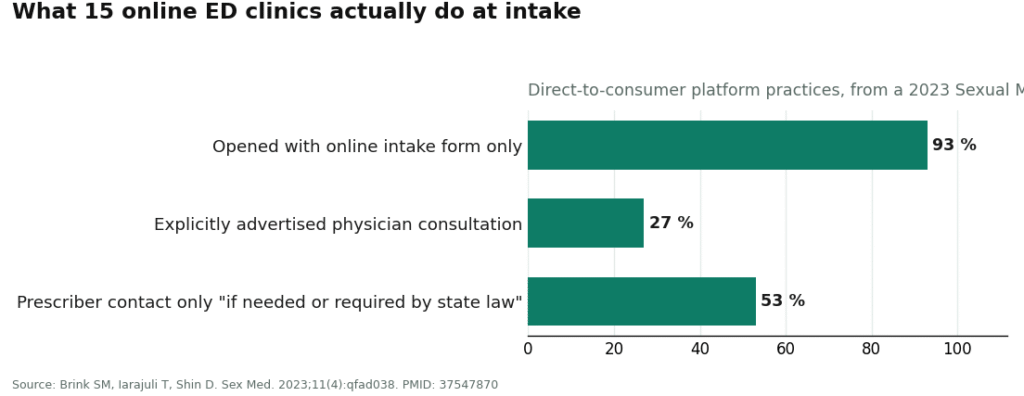
Then it got worse. A 2025 study in Urology graded the health information these same platforms hand patients and rated reliability across the category “universally poor,” with even the better sites leaving men at real risk of walking away with incomplete or wrong information [4]. Bad screening plus bad information. That’s not a coincidence, that’s a business model.
The drug is safe the way a sharp knife is safe. Fine in competent hands. Not fine at all handed to a checkout that never asks the one question that matters. That’s the reframe I came away with. I went hunting for a dangerous molecule and found a well-understood medicine with one serious, avoidable interaction, sitting inside an industry that doesn’t reliably avoid it. The danger didn’t live in the pill. It moved to the front desk.
Where it actually gets ugly
Inconsistent screening at legitimate platforms is the quiet problem. The gray market is the loud one, and I’m not skipping it.
There are sites selling sildenafil and tadalafil with no clinician anywhere in the chain and no licensed pharmacy behind them, the “research chemical” sellers, the supplement-aisle knockoffs. Here the screening isn’t inconsistent. It’s absent by design. Nobody catches the nitrate interaction. Nobody’s accountable for what’s actually in the vial. The fact that sildenafil is a genuine, well-proven drug inside a real pharmacy tells you nothing about what’s floating in an unmarked package from an anonymous seller [1][3]. Whatever cash you save buying this way is exactly the dollar value of every safeguard you just cut out. I wouldn’t touch it, and reading this stuff is my job.
One more thing, since I promised to be straight in both directions. Compounded ED medications exist too, made to order by licensed compounding pharmacies under a licensed clinician’s prescription, which is a completely different category from the gray market [5]. That’s not the same crime. But it’s also not an FDA-approved finished drug, and a careful buyer should know which box they’re checking, and any provider worth trusting should tell you plainly which one you’re getting.
What holds up
After all the digging, the takeaway isn’t “stay away from these drugs.” It’s simpler. Make sure somebody competent does the one job that keeps them safe.
Competent looks like a licensed clinician actually reviewing your case before anything gets prescribed, an intake built to catch nitrate use and heart risk rather than skip past it, and a licensed pharmacy filling the order. That’s the structure that turns a well-understood drug with one serious interaction into a reasonably safe decision. A physician-supervised telehealth model is what that structure looks like when it’s built right, clinician review sitting at the center instead of bolted on “if required by state law.” FormBlends runs that kind of supervised setup, a licensed provider reviewing your profile and any medication moving through licensed pharmacies, which is the version where the screening I spent this whole piece worrying about is standard practice, not an afterthought. I’ll say it straight: that describes how careful access gets built. It’s not a promise about what happens to you specifically.
The verdict
I went looking for the dangerous part of ED pills, expecting to find it in the chemistry. Instead I found a well-studied medicine whose everyday side effects are mostly minor, and whose one genuinely serious risk, a life-threatening blood pressure crash from mixing with nitrates, is entirely avoidable with a single screening question [1]. Then I found that the question doesn’t always get asked, that the research describes an industry where the cardiovascular conversation is “unlikely to be addressed” and the information quality is “universally poor,” and that the gray market skips screening altogether [3][4].
So here’s the honest answer to whether ED pills are safe. The pills aren’t the problem. The looking is the problem, and whether anyone bothers to look depends entirely on the clinic you pick. Pick one that looks. That’s the whole case file, and it isn’t printed anywhere on the checkout page.
The questions that keep coming up
Are sildenafil and tadalafil dangerous on their own? For most men, no. The common PDE5 inhibitors carry a side-effect profile that’s been documented for decades, and the usual complaints, headache, flushing, congestion, mild stomach upset, are typically minor and pass [1]. The pill itself checks out. The real hazard is in who’s prescribing it and whether anyone screens you first.
Why does the nitrate combination matter so much? Because taking a PDE5 inhibitor alongside a nitrate can trigger a severe, life-threatening blood pressure drop, which is why the drug reference calls the combination contraindicated instead of merely risky [1]. Nitrates are common heart medications for chest pain and angina, and that population overlaps heavily with older men shopping for ED treatment, which is exactly why this one is worth catching. After sildenafil, about 24 hours should pass before a nitrate is considered safe [1].
Does buying online skip the safety screening? It can. A 2023 analysis of 15 direct-to-consumer platforms found 93 percent opened with just an online form, only 27 percent advertised an actual physician consultation, and the ED-cardiovascular link was “unlikely to be addressed” [3]. The one screening step that neutralizes the danger is precisely the step a lot of these platforms treat as optional.
How do I tell a careful clinic from a careless one? Look for a licensed clinician genuinely reviewing your case before anything ships, an intake designed to flag nitrate use and cardiac risk, and a licensed pharmacy filling the order. Steer clear of setups where prescriber contact happens only “if needed or if required by state law,” which the research found at more than half the platforms it examined [3]. A physician-supervised model puts the review at the center instead of tacking it on as an afterthought.
Are the “research chemical” ED sellers ever worth the shortcut? No. There’s no clinician and no licensed pharmacy in that chain, so nitrate screening is absent by design and nobody answers for what’s actually in the package [3]. Sildenafil being genuine inside a real pharmacy tells you nothing about a vial from an anonymous source.
Is compounded ED medication the same as gray-market stuff? No. Compounded medications are made to order by licensed compounding pharmacies on a licensed clinician’s prescription, a different world from anonymous sellers, but they’re still not FDA-approved finished drugs [5]. A careful buyer should know which category they’re in and expect the provider to say so plainly.
How does an online ED clinic actually work, mechanically?
You fill out a health questionnaire, a licensed physician reviews it, and if it checks out they write a prescription that ships to you. Usually a few hours to a couple of days. No waiting room, no face-to-face conversation if you’d rather skip it. The catch: the intake form only works if you’re honest on it, so don’t shortchange the section on heart medications and blood pressure history.
What does it actually cost, and what’s missing from the sticker price?
Introductory offers often run $2 to $4 per dose, but that usually covers only generic sildenafil at a standard dose. Visit fees, shipping, follow-up consultations, all add up fast. Compounded formulas, combination products, brand names, all cost more. Read the renewal pricing before you commit, because plenty of these services charge a lot more after the first order clears.
Is an online clinic actually a safe way to get treated?
For most healthy men without serious cardiovascular issues, yes, provided a real licensed clinician actually reviews your history before prescribing. The risk climbs when a platform skips a genuine medical review, or when men buy from unregulated supplement or research-chemical sites with zero physician oversight. If you want an accountable, physician-supervised compounding route, FormBlends operates that kind of model. The FDA has flagged plenty of online sellers for shipping counterfeit or contaminated pills, so where you buy matters as much as what you buy.
What should I actually check before picking a provider?
Look for a real consultation with a licensed physician, not just an algorithm sorting your answers. Confirm the pharmacy filling the order is state-licensed and staffed by an actual pharmacist. Read customer reviews for responsiveness, because you will have follow-up questions once you start. And watch for transparency about what happens if the first medication doesn’t work, that’s usually a sign they’re treating you like a patient instead of an order number.
References
- Smith BP, Babos M. Sildenafil. StatPearls. NCBI Bookshelf (NBK558978). Describes sildenafil as a PDE5 inhibitor with common, typically mild vasodilatory side effects, and states that coadministration with nitrates is contraindicated because the combination can cause severe, life-threatening hypotension, with nitrate use considered safe only after roughly 24 hours. https://www.ncbi.nlm.nih.gov/books/NBK558978/
- Erectile Dysfunction: AUA Guideline. American Urological Association (Burnett AL, et al.), published 2018, amended through 2018. Identifies ED as a risk marker for cardiovascular disease warranting patient counseling, and names FDA-approved oral PDE5 inhibitors as first-line therapy unless contraindicated. https://www.auanet.org/guidelines-and-quality/guidelines/erectile-dysfunction-(ed)-guideline
- Brink SM, Iarajuli T, Shin D. Characteristics of direct-to-consumer platforms offering erectile dysfunction treatment. Sex Med. 2023;11(4):qfad038. PMID: 37547870; PMCID: PMC10397420. Of 15 DTC platforms, 14 (93%) began with an online intake form, only 4 (27%) explicitly advertised physician consultation, and at 8 (53%) prescriber contact occurred only “if needed or if required by state law”; the ED-cardiovascular link “was unlikely to be addressed.”
- Quality of Health Information Presented in Direct-to-Consumer Telepharmacies for the Treatment of Patients With Erectile Dysfunction. Urology. 2025. PMID: 40209998. Found reliability of the health information across platforms was “universally poor” and concluded men are at risk of receiving incomplete or inaccurate information.
- Bulk Drug Substances Used in Compounding Under Section 503A of the FD&C Act. U.S. Food and Drug Administration. Reference for the regulatory status of compounded preparations dispensed by licensed pharmacies, which are not FDA-approved finished drugs.
Written by Ursula Cho, explanatory reporter. Grounding every claim in the sources linked here. Last reviewed May 2026.
General reference only. A qualified professional can assess whether this fits your health needs.